Is Dubai Property a Bubble? What the 2026 Data Actually Says


Short answer: On the 2026 data, Dubai property is in a correction, not a 2008-style bubble burst. Citywide values are down about 10% since 28 February 2026, when a regional conflict began, and Q3 2026 residential sales fell 47% year on year. But the structure underneath is different from 2008: roughly three in four purchases are cash or developer-funded rather than bank mortgages, every off-plan dirham sits in a RERA-supervised escrow account, only about 4% of homes were resold within a year in 2025 against 25% in 2008, and the population is still growing by around 300,000 people a year. UBS still rates Dubai an elevated bubble risk (4th of 23 cities in its 2026 index) and the agencies expect prices to drift lower into 2027 as a record supply wave lands. The risk is real, it's concentrated in apartments, and it looks like a slow deflation rather than a collapse.
Key takeaways
- Prices are already falling. ValuStrat's index was down 10.2% from February to August 2026, the first annual decline for villas in five years.
- Volumes fell harder than prices. Q3 2026 saw about 34,000 residential sales worth AED 72.6 billion, down 38% and 47% respectively on Q3 2025.
- This is not 2008-style debt. Mortgages were about 24% of 2025 transactions by count, real estate is about 13% of bank loans, and escrow has been law since 2007.
- Supply is the real pressure. Around 120,000 to 131,000 units were scheduled for 2026 and 162,500 for 2027, more than 80% of them apartments. Historically under half arrive on time.
- Villas and apartments are not one market. In August 2026 villas were down 1.7% year on year and apartments 5.3%; some villa communities were still rising.
What has actually happened to Dubai prices in 2026?
Start with the number everyone argues about. ValuStrat's price index, which tracks a fixed basket of freehold homes, peaked in February 2026 after five straight years of growth. Then a regional conflict broke out on 28 February and the index dropped 5.9% in March alone. The monthly falls have shrunk every month since, but they haven't stopped.
| ValuStrat reading | Citywide index | Change | Villas | Apartments |
|---|---|---|---|---|
| December 2024 | 200.7 | +27.5% YoY | +31.6% YoY | +23.6% YoY |
| December 2025 | 240.4 | +19.8% YoY | +25.1% YoY | +14.2% YoY |
| March 2026 | 229.2 | -5.9% MoM | -5.8% MoM | n/a |
| June 2026 | 220.0 | +0.1% YoY, -10% since Feb | +2.0% YoY | -3.0% YoY |
| August 2026 | 218.8 | -3.1% YoY, -10.2% since Feb | -1.7% YoY | -5.3% YoY |
ValuStrat Price Index, base January 2021 = 100. Sources: Khaleej Times (13 Jan 2025, 9 Sep 2026); ValuStrat (7 Jan 2026, March 2026); Zawya (June 2026).
Volumes tell the sharper story. Dubai closed 2025 at a record: more than 270,000 transactions worth AED 917 billion, up 20% on 2024, on the Department of Finance's figures. Nine months later, Cavendish Maxwell's Q3 2026 numbers reported by The National show about 34,000 residential sales worth AED 72.6 billion, down 38% by count and 47% by value on the same quarter of 2025. S&P puts the monthly average at 12,644 sales from March to September against 17,198 in January and February.
So the honest starting point is this: whatever you call it, the market has already repriced by about a tenth, and buyers have stepped back by about a third. The question that matters for anyone holding or buying a Dubai home is whether that's the start of 2008 again, or a correction the market can absorb. The answer depends on four things: how far prices had run, how much supply is coming, who is carrying the debt, and whether people are still arriving.
How does 2026 compare with 2008 and 2014?
Dubai has had two real downturns in the freehold era, and they weren't alike.
| Cycle | Peak to trough | What drove it | What stopped it |
|---|---|---|---|
| 2008 to 2011 | More than 50% off the mid-2008 peak (S&P) | 10% deposits, flipping before completion, global credit freeze, no escrow enforcement | Abu Dhabi support, Expo 2020 win in 2013, new mortgage caps |
| 2014 to 2019 | 25% to 33% nominal (S&P, Feb 2019) | Oil price collapse, strong dollar, steady oversupply | Covid reset, remote work migration, Golden Visa expansion |
| 2026 to date | About 10% since February (ValuStrat) | Regional conflict, record supply schedule, prices 80% to 120% above 2020 | Still in progress |
Dubai residential downturns compared. Sources: Gulf News citing S&P; ME Construction News, 20 Feb 2019; Khaleej Times, 9 Sep 2026.
The 2008 crash was a leverage event. Buyers were putting 10% down on units that didn't exist and selling the paper before the next instalment. Knight Frank's Faisal Durrani has the cleanest measure of it: in 2008 about 25% of homes were resold within 12 months. In 2025 that figure was 4%, per Khaleej Times. When the credit stopped in late 2008, there was nobody left to hold the units. Roughly 217 projects were cancelled between 2009 and 2011 and buyers lost deposits with no legal route to get them back.
That last part is what changed. Law No. 8 of 2007 already required project escrow accounts, but it was the post-crash enforcement, plus Oqood registration under Law 13 of 2008 and the Special Tribunal for cancelled projects, that made it bite. Today a developer can only draw buyer money against certified construction progress, and a 5% retention stays locked for a year after completion. We explain what that means in practice in what happens if a Dubai developer delays or cancels a project.
How far had prices run before this correction? Knight Frank's Q3 2025 review had apartments 69% above Q1 2020 and villas 124% above. ValuStrat's June 2026 reading, after the first wave of falls, still had older villa communities 188% above their post-pandemic level and 76% above the 2014 peak, while older apartment communities sat 70% above post-pandemic and 8% below the 2014 peak. Nobody publishes a clean comparison against mid-2008, but with the market more than 50% off that peak by 2010 and now 20% to 30% above the 2014 peak, prices in 2026 are above 2008 in nominal terms. In real terms, after sixteen years of inflation, the gap is much smaller than it looks.
The supply question: how many homes are really coming?
If there's a bubble argument that holds up, it's supply. Fitch counted about 120,000 units scheduled for 2026 and ValuStrat's pipeline has 131,234. Cavendish Maxwell's schedule for 2027 is 162,500 units, then 128,200 in 2028. Moody's puts it at roughly 180,000 homes over 2026 to 2028, about 60,000 a year against a historical 30,000 to 40,000. Against a stock of around 935,000 homes at the end of 2025, that's a lot.
The schedule and the delivery are different things, though. Dubai has never hit its handover calendar.
| Period | Scheduled | Delivered | Source |
|---|---|---|---|
| 2024 | n/a | 34,700 | Cavendish Maxwell |
| 2025 | 82,600 (early projection) | 40,400 | Cavendish Maxwell |
| H1 2026 | n/a | 24,800 (18,900 apartments, 5,900 villas and townhouses) | Cavendish Maxwell via Khaleej Times |
| H2 2026 | 47,000 | 14,000 to 23,500 expected (30% to 50%) | Cavendish Maxwell |
| 2022 to 2024 | n/a | 60% on-time delivery rate | Knight Frank |
| Q1 to Q3 2025 | n/a | 46% on-time delivery rate | Knight Frank |
Dubai residential completions, scheduled versus delivered. Sources: Cavendish Maxwell (via IndexBox, 30 Jul 2026, and Khaleej Times, 30 Jul 2026); Knight Frank Q3 2025 review.
Two more details shape where the pressure lands. Khaleej Times reported in February 2026 that about 66% of upcoming units are studios and one-beds, and that around 45% of the under-construction stock sits in five areas: JVC and JVT, Dubai South, MBR City's apartment districts, Business Bay and Dubailand Residence Complex. And villas are roughly 19% of the 2026 pipeline on ValuStrat's count, with 2025 launches running 89% apartments. The supply wave is an apartment wave.
Launches have also collapsed, which is how a market self-corrects. H1 2026 saw 28,000 units launched in 124 projects against 102,000 units in 410 projects a year earlier, per Cavendish Maxwell. Developers read the same data as everyone else. We covered the villa side of this in where the new villa projects actually are and the bigger picture in our 2027 market forecast.
Who is holding the risk: cash, mortgages and the banks
A bubble needs borrowed money to burst. In 2008 the money was borrowed. In 2026 most of it isn't.
- Mortgages were about a quarter of 2025 deals. The DLD recorded 50,974 mortgage registrations against 214,912 sales, roughly 24% by count and 26% by value on the 2025 breakdown, and some of those registrations are refinancing rather than purchases.
- Cash dominates the secondary market. Betterhomes reported 61% of its Q2 2026 deals were cash, in its quarterly report.
- Off-plan runs on developer payment plans, which were 72% to 76% of 2025 sales. The Central Bank caps a bank mortgage on an off-plan unit at 50% loan-to-value for everyone.
- The banks are lightly exposed. S&P put real estate and construction at about 13% of UAE bank loans in September 2026, with Stage 3 (non-performing) loans at the top ten banks at 2.3% against 6.1% in 2021, per Gulf News. Fitch has corporate real estate at 13% of gross loans, down from 20% at the end of 2021.
| Buyer and property | Maximum loan-to-value |
|---|---|
| First home up to AED 5 million, UAE national | 85% |
| First home up to AED 5 million, expatriate | 80% |
| First home above AED 5 million, expatriate | 70% |
| Second or investment property, expatriate | 60% |
| Off-plan property, any buyer | 50% |
UAE Central Bank mortgage caps, Circular 31/2013 as amended in April 2020. Maximum term 25 years; repayments capped at 50% of income.
Fitch's view has moved with events. In May 2025 it said the correction "should not exceed 15%". By April 2026 it expected a larger correction than forecast because of the conflict, and warned that real estate would be the main source of new bad loans if it dragged on, per Fortune. That's the right way to read the debt picture: low enough that a price fall doesn't become a banking crisis, not so low that it doesn't matter. If you're financing a purchase, our mortgage calculator guide runs the numbers at today's caps.
What the bubble indices and rating agencies say

Dubai's investment-grade critics are consistent, and none of them use the word crash.
| Source | Date | View |
|---|---|---|
| UBS Global Real Estate Bubble Index | 22 Sep 2026 | "Elevated risk", score 1.16, 4th of 23 cities; imbalances intensified but "bubble risk in Dubai has eased since March" |
| Fitch Ratings | May 2025, updated Apr 2026 | Correction of up to 15% from mid-2025, now "larger than forecast" because of the conflict |
| Moody's | 10 Feb 2026 | "Modest cooling" over 12 to 18 months; outright declines probable in mid-market apartments |
| S&P Global | Oct 2026 | "Gradual price correction rather than a rapid decline"; apartments to fall faster than villas; industry reports put prices down 5% to 15% since end-2025 |
| Emaar chairman Mohamed Alabbar | Sep 2026 | Expects a "5% to 10% adjustment" with balance returning in 2027 |
Published views on the Dubai market, 2025 to 2026. Sources: UBS press release; The National, 24 Sep 2026 and 7 Oct 2026; Gulf News, 29 May 2025; Fortune, 1 Jun 2026; The National, 10 Feb 2026.
The UBS score is worth a closer look because it's the one headline writers reach for. Dubai moved from 0.64 (moderate) in 2024 to 1.09 in 2025 and 1.16 in 2026, per The National. UBS treats anything above 1.5 as outright bubble territory; Zurich sits at 1.69 and Tokyo at 1.54. Dubai is in the elevated band with Miami, Seoul, Geneva and Lisbon. The same report notes that a skilled worker needs about five years' income to buy a 60 sq m flat in Dubai, against 11 in London and 15 in Hong Kong. Expensive for Dubai, cheap for a global city.
Notice what the agencies agree on. The correction is supply-led and apartment-led. The banks can take it. And the base case is a grind lower into 2027 rather than a cliff. That is also roughly what has happened so far: after the 5.9% March drop, ValuStrat recorded falls of 1.9%, 1.2%, 1.0%, 0.3% and 0.2% in the five months to August.
Is it a bubble, then? Our read, and what it means for a villa buyer
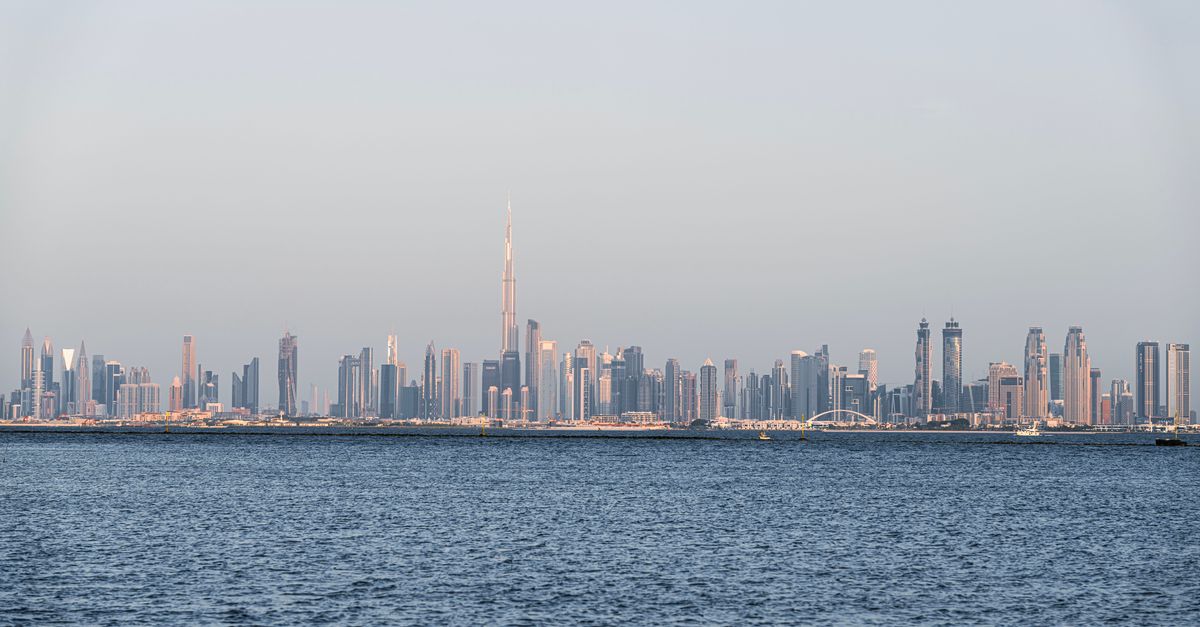
We build villas in Dubai, so you should weigh our view accordingly. Here it is anyway. The evidence says Dubai had a strong five-year run that got ahead of rents, and 2026 is the market paying some of that back under the worst possible external conditions. It doesn't say the market is hollow. Three facts carry most of the weight:
- Demand is still physical. Dubai added 332,000 residents in 2025 and another 226,885 by 29 September 2026, reaching 4.81 million on government figures. Dubai issued 66,078 Golden Visas in the first half of 2026 alone, per Gulf News. People who move here need somewhere to live, whatever the index does.
- Rents are holding better than prices. Gross yields were 6.34% citywide in August 2026 on Property Monitor data (apartments 6.66%, villas 4.45%), per Engel & Völkers. UBS has real rents down 4% in the year to Q2 2026 against real prices up 0.4%, so the gap is narrowing from the price side, which is how a soft landing looks.
- The speculative layer is thin. 4% of homes resold within a year in 2025, escrow holds the off-plan money, and three in four buyers aren't using a bank.
None of that makes prices immune. The August data shows how uneven the correction is. On ValuStrat's annual figures, villas in Mudon were down 8.2%, Dubai Hills Estate 6.8% and Palm Jumeirah 6.2%, while Jumeirah Islands was up 12.2% and Emirates Hills 7.4%. Apartments around the Burj Khalifa were down 20.4% and JBR 16.9%, while Silicon Oasis and Sports City gained about 4%. Six in ten freehold communities were flat or up, per Khaleej Times. Averages are hiding a lot of local stories, and off-plan apartments bought at 2025 launch prices are the units most likely to be under water in the resale market.
For a villa buyer, that points to four rules. Buy land that can't be added to, which in practice means established villa districts close to Downtown rather than the apartment belt; we laid out why in why MBR City villa supply is tighter than you think. Pay for a built or near-complete home rather than a launch-day render, so the delivery slippage in the table above is the developer's problem and not yours. Check the escrow and the RERA registration yourself using the five developer checks. And price in a flat 2027. If the purchase only works on 10% annual growth, it doesn't work.
That is how we have set up our own communities. Selora Residences is 32 villas in District 11 of Mohammed Bin Rashid City, about 10 to 15 minutes from Downtown, on plots from 4,667 sq ft, with every buyer payment held in a RERA-supervised escrow account. Lua Residences is in the same district. Both are low-density by design, in a part of the city where no new villa plots are being released. If you want to look at either with the 2026 numbers in front of you, talk to the Swank team. We'll show you the escrow account before we show you the brochure.
Frequently asked questions
Is Dubai property a bubble in 2026?
The data points to a correction rather than a bubble burst. Values fell about 10% between February and August 2026 after a regional conflict began, and Q3 sales were down 47% by value. But mortgages were only about a quarter of 2025 deals, off-plan money sits in escrow by law, only 4% of homes were resold within a year in 2025, and the population is still growing by roughly 300,000 a year. UBS rates Dubai an elevated risk, not a bubble.
How much have Dubai property prices fallen in 2026?
ValuStrat's citywide index was down 10.2% from February to August 2026 and 3.1% year on year. Villas were down 1.7% year on year and apartments 5.3%. Some areas fell much more: apartments around the Burj Khalifa were down 20.4% and in JBR 16.9%.
Will Dubai property crash like 2008?
The conditions are different. In 2008 about 25% of homes were resold within a year on 10% deposits and bank credit; in 2025 the figure was 4%, around three in four purchases were cash or developer-funded, and real estate is about 13% of bank loans. Fitch, Moody's and S&P all forecast a gradual correction rather than a rapid decline.
What does the UBS Global Real Estate Bubble Index say about Dubai?
The September 2026 edition rates Dubai an elevated bubble risk with a score of 1.16, fourth of 23 cities, up from 1.09 in 2025 and 0.64 in 2024. UBS also said bubble risk in Dubai had eased since March 2026. Scores above 1.5, such as Zurich and Tokyo, count as high risk.
Is there an oversupply of property in Dubai?
There is a large scheduled pipeline: about 120,000 to 131,000 units for 2026 and 162,500 for 2027, more than 80% apartments. Historically only 46% to 60% of scheduled units arrive on time, and launches fell by more than two thirds in H1 2026, so the real supply shock is smaller and slower than the schedule suggests. It is concentrated in studios and one-bed apartments.
Are villas safer than apartments in a Dubai downturn?
In this cycle, so far, yes. Villas were down 1.7% year on year in August 2026 against 5.3% for apartments, villas are under 20% of new supply, and 73% of freehold villa communities were stable or rising against 61% of apartment communities. Villas still fell in some communities, including Mudon, Dubai Hills Estate and Palm Jumeirah.
Is 2026 a good time to buy property in Dubai?
It depends on what and where. Prices are about 10% below the February 2026 peak, sellers are negotiating, and the agencies expect a further gradual decline into 2027. A built villa in an established central district bought at a price that works with zero growth is a different proposition from an off-plan studio in an oversupplied apartment district.
Sources & further reading: Khaleej Times: ValuStrat August 2026 index · ValuStrat: December 2025 performance · Zawya: ValuStrat June 2026 VPI · The National: Q3 2026 transactions · Dubai Department of Finance: 2025 transactions · UBS: Global Real Estate Bubble Index 2026 · The National: UBS report on Dubai · Fortune: Fitch on the 2026 correction · Gulf News: S&P on UAE banks · Knight Frank: Q3 2025 residential review · Khaleej Times: Knight Frank on resale rates · Dubai Law No. 8 of 2007 (escrow) · Khaleej Times: oversupply analysis, Feb 2026
Written by Faizan Ahmed, Digital & SEO Lead, Swank Development. Last updated 8 October 2026. Figures are indicative and were verified against official UAE government sources at the time of writing; always confirm current fees with the Dubai Land Department or your conveyancer.